High Level Design
Consistency & Isolation in Distributed Systems
Consistency models (linearizable, eventual, causal, quorum), database transactions, and the four isolation levels — from read uncommitted to serializable.
In distributed systems, consistency means how up-to-date a piece of data is across all nodes.
Consistency Levels#
Linearizable Consistency#
The strongest model. Every read reflects the result of the latest completed write — no matter which node served it.
write x = 13 → write x = 17 → read x → 17  ✅
write x = 1  → read x → 1                   ✅
| ✅ Pros | Predictable behavior; simplifies debugging; ideal for financial transactions |
| ❌ Cons | High latency (requires coordination); low availability; scalability limits |
| Implementation | Paxos, Raft, replicated state machines, quorum-based systems |
Eventual Consistency#
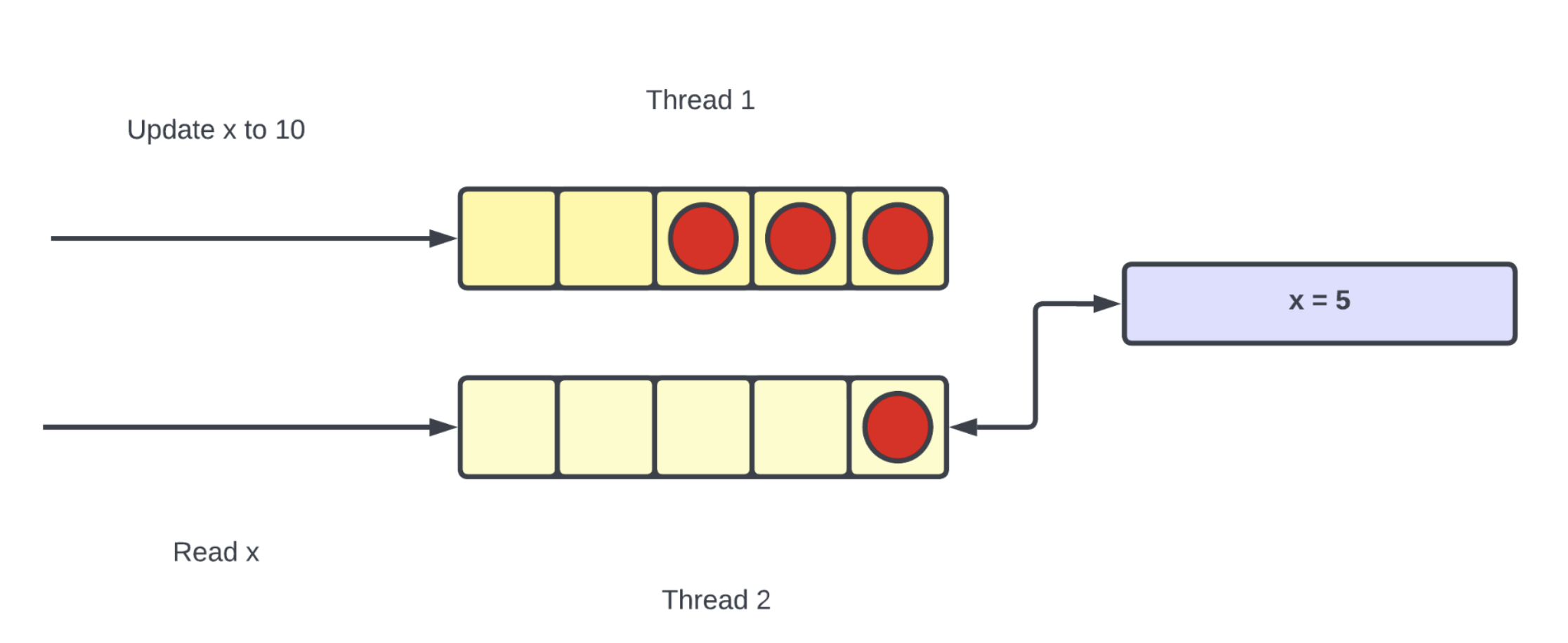
The weakest model. Replicas may temporarily return stale data, but will converge to the latest value over time.
write x = 10 → read x → 5  (stale)
...time passes...
read x → 10  ✅ (eventually consistent)
| ✅ Pros | Highly available; low latency; scalable |
| ❌ Cons | Temporary stale reads; not suitable for financial apps |
| Used by | Amazon DynamoDB, Cassandra, Riak, Couchbase |
Causal Consistency#
A middle ground. Causally related operations must be seen in the same order by all nodes. Unrelated operations can be seen in any order.
update x = 20 → read x (must see 20)  ✅
update y = 10  is independent → can execute in parallel
| ✅ Pros | Stronger than eventual; better performance than linearizable |
| ❌ Cons | Fails for multi-key aggregations; complex to implement |
| Used by | Cassandra (tuned), COPS, Bayou |
Quorum#
A configurable model. Reads/writes require acknowledgement from a majority of replicas.
Formula for strong consistency:
R + W > N
- R = min replicas to read from
- W = replicas to write to
- N = total replicas
If R + W ≤ N → eventually consistent.
| ✅ Pros | Fault-tolerant; configurable consistency/performance balance |
| ❌ Cons | Higher cost; split-brain risk with even node counts; latency |
| Used by | Cassandra, DynamoDB, Riak, MongoDB |
Consistency Level Trade-offs#
| Level | Consistency | Efficiency |
|---|---|---|
| Linearizable | Highest | Lowest |
| Causal | Medium-high | Medium |
| Quorum | Configurable | Configurable |
| Eventual | Lowest | Highest |
Database Transactions#
A transaction is a collection of queries that form one unit of work. Transactions are atomic — either all queries execute or none do.
- BEGIN — marks the start
- COMMIT — persists all changes
- ROLLBACK — undoes all changes
Isolation Levels#
Isolation controls how transactions interact with each other when running concurrently.
Read Uncommitted#
Allows reading data that another transaction has written but not yet committed.
- Problem: Dirty reads — you read a value that gets rolled back.
- ✅ Fastest; minimal locking overhead
- ❌ No data accuracy guarantee
Example:
T1: write x = 10 → ROLLBACK
T2: read x → 10  ❌ (dirty read — this value never persisted)
Read Committed#
Only reads committed data. Eliminates dirty reads.
- ✅ Prevents dirty reads
- ❌ Non-repeatable reads — same row can return different values within a transaction if another transaction commits an update in between
Example: T2 reads x=10, T1 updates and commits x=20, T2 reads again and sees x=20 — two different values in the same transaction.
Repeatable Reads (Most Used)#
If you read a row once in a transaction, subsequent reads return the same value, even if another transaction commits updates.
- Uses row-level locks or MVCC (Multi-Version Concurrency Control)
- ✅ Prevents dirty reads and non-repeatable reads
- ❌ Still allows phantom reads (new rows inserted by another transaction appear)
Optimistic Concurrency Control: If two transactions try to update the same row, only one succeeds; the other rolls back.
Serializable#
The strongest isolation level. Transactions execute as if they were serial (one after another). No other transaction can interfere.
- Prevents phantom reads (uses predicate-based locking)
- Uses strict two-phase locking (S2PL) or timestamp-based ordering
- ✅ Prevents dirty reads, non-repeatable reads, and phantom reads
- ❌ Least efficient due to heavy locking
Summary#
| Isolation Level | Implementation | Prevents |
|---|---|---|
| Read Uncommitted | Single data entry | Nothing |
| Read Committed | Local copy of changed values | Dirty reads |
| Repeatable Read | Versioning of unchanged values | Dirty reads + non-repeatable reads |
| Serializable | Queued locks / causal ordering | All anomalies |
Efficiency: Read Uncommitted > Read Committed > Repeatable Read > Serializable
Isolation: Read Uncommitted < Read Committed < Repeatable Read < Serializable